





Table of contents

Get treated by pain treatment industry leaders
Achilles Tendinitis: Understanding Heel Pain and Recovery

Medically verified
Last updated on 03/17/2026

By Dr. George Hanna
Pain Doctor at Pain Treatment Specialists
University of Pennsylvania
Double Certified in Anesthesiology and Pain Medicine.
Achilles tendinitis is a common and often debilitating condition that affects the largest tendon in the body. Because the Achilles tendon connects the calf muscles to the heel bone, any inflammation in this area can significantly impact your ability to walk, run, and engage in daily physical activity.

At Pain Treatment Specialists, we use an academic care model to address the structural integrity of the Achilles tendon. By utilizing precision diagnostics and minimally invasive procedures, we help our patients resolve heel pain and restore functional mobility without the need for invasive surgery.
What is Achilles Tendinitis?
Achilles tendinitis occurs when the thick fibrous cord at the back of your ankle becomes overloaded, leading to localized inflammation and microscopic tearing. This condition typically presents in two forms: non-insertional, which affects the middle portion of the tendon, and insertional, which occurs at the point where the tendon attaches to the heel bone. Both types result from repetitive strain—often due to a sudden increase in exercise intensity or poor footwear—and can lead to a persistent "tight" sensation and sharp pain during the first steps of the morning.
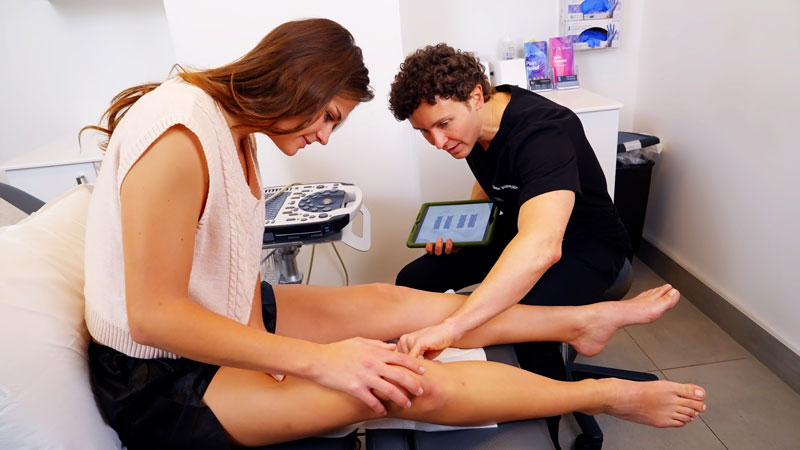
The primary risk of leaving Achilles irritation unaddressed is the development of a tendon rupture or permanent scarring. At Pain Treatment Specialists, we view Achilles tendinitis as a mechanical issue that requires a specialized clinical response. Our board-certified physicians use high-resolution ultrasound to visualize the tendon’s thickness and detect any signs of fluid accumulation or calcification. This diagnostic clarity is essential for determining what causes tendonitis in your specific case and ensuring that your tendonitis treatment plan prevents long-term structural damage.
Signs, Symptoms, and Functional Impact
The symptoms of Achilles tendinitis usually start as a mild ache in the back of the leg or above the heel after physical activity. Over time, you may notice significant stiffness in the morning that improves as the tendon warms up, as well as a visible "bump" or thickening on the tendon itself. For many, the pain is exacerbated by uphill walking or stair climbing, as these actions place maximum tension on the inflamed fibers. This is similar to how hip tendonitis symptoms restrict movement by making the body’s primary "levers" painful to operate.
Understanding the progression of these symptoms is a core part of our academic approach. If you are experiencing a "squeaking" sensation or persistent heat at the back of the ankle, it is a signal that the tendon sheath is severely irritated. Our specialists intervene with medical strategies that neutralize this inflammation, often utilizing tendonitis therapy techniques like eccentric heel drops to rebuild the tendon’s strength. By addressing the clinical markers of the condition early, we help you avoid the functional decline that often follows chronic ankle instability.

"I've been walking more and I don't feel that excruciating pain"
Joseph
Knee pain patient
"I'm feeling better and sleeping much more."
Charina
Back pain patient
"My knees have never felt better, I'm so happy"
Jasmin
Knee pain patient
"I immediately felt the relief and a lot of comfort."
Carlos
Knee pain patient
Non-Surgical Relief and Recovery
Modern interventional medicine offers highly effective non-surgical pathways for resolving Achilles pain. Ultrasound-guided injections are a primary tool, used to deliver anti-inflammatory medication or regenerative substances precisely into the peritendinous space. Additionally, for chronic cases where scar tissue has formed, we may utilize minimally invasive procedures to clear away damaged tissue and stimulate a healthy healing response. These treatments are designed to provide a definitive resolution to what is tendonitis at the heel, allowing you to return to an active lifestyle safely.
A consultation at Pain Treatment Specialists provides the expert clarity needed to move forward with confidence. Our board-certified physicians specialize in non-surgical recovery, offering the same high-level expertise found at top academic medical institutions. We take the time to explain your specific diagnosis and how advanced techniques can resolve your ankle pain. If Achilles tendinitis is stopping you from staying active, a professional diagnostic workup is the most reliable first step toward achieving a life that is no longer defined by joint and tendon inflammation.
Most PPO insurances cover pain treatment!
and 100+ more
Questions about your insurance coverage?
We know health insurance is confusing, fortunately our expert team is always willing to help!
Just call us (877) 461-0819 to verify your coverage or answer any concern you may have.

About the Medical Team at Pain Treatment Specialists

At Pain Treatment Specialists, our approach is rooted in an academic, evidence-based model of care that prioritizes patient safety and long-term outcomes. Our clinicians are trained at the nation’s leading medical institutions, bringing a high level of expertise to the diagnosis and treatment of complex pain conditions.
Clinical leadership at Pain Treatment Specialists is guided by a panel of board-certified specialists responsible for establishing and maintaining the clinic’s medical standards. Their approach reflects training developed at nationally recognized academic institutions such as Harvard, Yale, and Columbia.
All physicians follow a structured, highly standardized clinical model. This includes ongoing training in the latest non-surgical treatments, continuous review of emerging research, and strict adherence to proven safety and quality protocols to ensure consistent results.
If you’re experiencing symptoms and want clarity about the cause, a medical evaluation can help guide the next step. Schedule a Consultation

See how we change lives
Start Your Journey to
Pain-Free Life
At Pain Treatment Specialists, education is considered a core part of treatment. Patients are encouraged to understand their condition, their options, and the reasoning behind each recommendation to foster a collaborative recovery environment.
If you’re experiencing symptoms and want clarity about the cause, a medical evaluation can help guide the next step.
Take control, start feeling better
Take the first step to personalized care for your type of acute and chronic pain. One of our patient coordinators will call you to schedule your visit and verify insurance coverage.
