





Table of contents

Get treated by pain treatment industry leaders
Bursitis Locations: Shoulders, Hips, Knees, and Elbows

Medically verified
Last updated on 03/17/2026

By Dr. George Hanna
Pain Doctor at Pain Treatment Specialists
University of Pennsylvania
Double Certified in Anesthesiology and Pain Medicine.
Bursitis can manifest in any of the body’s major joints, but it most frequently affects the shoulders, hips, knees, and elbows. Identifying the specific bursa involved in your discomfort is the essential first step toward neutralizing inflammation and restoring your functional range of motion.
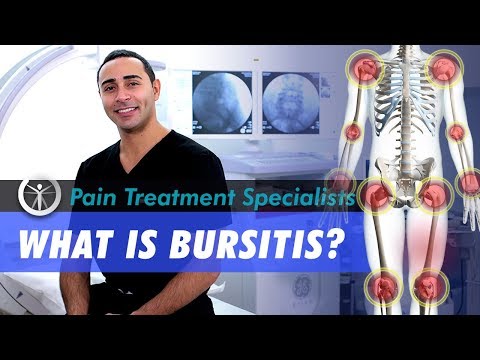
At Pain Treatment Specialists, we use an academic care model to diagnose and treat bursa inflammation across all anatomical sites. By utilizing precision diagnostics and minimally invasive procedures, we help our patients resolve localized joint pain and return to their active lifestyles.
Bursitis of the Shoulders and Hips
The shoulders and hips are the most common sites for chronic bursitis due to their wide range of motion and weight-bearing requirements. Shoulder bursitis (subacromial bursitis) often presents as pain when reaching overhead or sleeping on the affected side. It is frequently associated with rotator cuff impingement, where the bursa becomes “pinched” between bone and tendon. In the hip, trochanteric bursitis causes sharp or aching pain on the outer side of the upper thigh. This is typically aggravated by walking, climbing stairs, or lying down, as these movements increase the friction between the bursa and the iliotibial (IT) band.
Treating these deep-joint bursae requires clinical precision. At Pain Treatment Specialists, our board-certified physicians use ultrasound-guided injections to deliver anti-inflammatory medication directly into the subacromial or trochanteric bursa. This targeted approach “shuts off” the inflammation at its source, providing rapid relief that systemic medications often cannot achieve. By resolving the pain in these primary joints, we prevent the “compensatory” issues that often lead to secondary pain in the neck, lower back, or knees.
Bursitis of the Knees and Elbows
Unlike the deep bursae of the hip and shoulder, bursitis in the knees and elbows often involves more superficial sacs that are prone to trauma and pressure. Elbow bursitis (olecranon bursitis) typically presents as a visible, fluid-filled swelling at the tip of the elbow, often caused by leaning on hard surfaces or sudden impact. Knee bursitis (prepatellar bursitis), also known as “housemaid’s knee,” involves swelling over the kneecap. This is common in individuals whose occupations require frequent kneeling. Both conditions result in localized tenderness, heat, and a restricted ability to fully bend the affected joint.
Because these bursae are located just beneath the skin, they are particularly susceptible to infection (septic bursitis). Our academic approach prioritizes a careful diagnostic workup to rule out infection before proceeding with interventional care. For non-infected inflammatory cases, we utilize aspiration to remove excess fluid and guided injections to reduce the bursa wall’s thickness. This combined strategy immediately reduces the visible swelling and restores the mechanical gliding function of the joint. Our goal is to provide a definitive resolution that allows you to return to work or sport without the hindrance of recurring joint fluid.

"I've been walking more and I don't feel that excruciating pain"
Joseph
Knee pain patient
"I'm feeling better and sleeping much more."
Charina
Back pain patient
"My knees have never felt better, I'm so happy"
Jasmin
Knee pain patient
"I immediately felt the relief and a lot of comfort."
Carlos
Knee pain patient
A Comprehensive Approach to Joint Relief
Regardless of the location, the key to a permanent resolution for bursitis is identifying the underlying mechanical trigger. Whether it is poor throwing mechanics in the shoulder or a leg-length discrepancy affecting the hip, a bursa rarely inflames in a vacuum. Once we have neutralized the acute inflammation through interventional procedures, we integrate functional rehabilitation to strengthen the supporting muscles. This “stabilization” phase ensures that the bursa is no longer subjected to the uneven loads and friction that caused the initial irritation, effectively preventing the condition from becoming a chronic issue.
A consultation at Pain Treatment Specialists provides the expert clarity needed to understand your joint health. Our board-certified physicians specialize in non-surgical recovery, offering the same level of care and expertise found at top academic medical institutions. We take the time to explain your specific diagnosis and how our advanced techniques can resolve your pain safely. If bursitis in your shoulders, hips, knees, or elbows is stopping you from enjoying your life, a professional diagnostic workup is the most reliable first step toward achieving a life that is no longer defined by joint inflammation.
Most PPO insurances cover pain treatment!
and 100+ more
Questions about your insurance coverage?
We know health insurance is confusing, fortunately our expert team is always willing to help!
Just call us (877) 461-0819 to verify your coverage or answer any concern you may have.

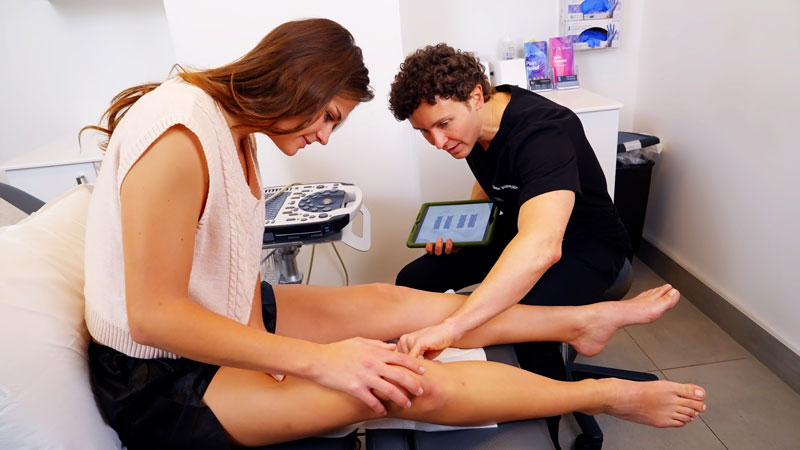
About the Medical Team at Pain Treatment Specialists

At Pain Treatment Specialists, our approach is rooted in an academic, evidence-based model of care that prioritizes patient safety and long-term outcomes. Our clinicians are trained at the nation’s leading medical institutions, bringing a high level of expertise to the diagnosis and treatment of complex pain conditions.
Clinical leadership at Pain Treatment Specialists is guided by a panel of board-certified specialists responsible for establishing and maintaining the clinic’s medical standards. Their approach reflects training developed at nationally recognized academic institutions such as Harvard, Yale, and Columbia.
All physicians follow a structured, highly standardized clinical model. This includes ongoing training in the latest non-surgical treatments, continuous review of emerging research, and strict adherence to proven safety and quality protocols to ensure consistent results.
If you’re experiencing symptoms and want clarity about the cause, a medical evaluation can help guide the next step. Schedule a Consultation

See how we change lives
Start Your Journey to
Pain-Free Life
At Pain Treatment Specialists, education is considered a core part of treatment. Patients are encouraged to understand their condition, their options, and the reasoning behind each recommendation to foster a collaborative recovery environment.
If you’re experiencing symptoms and want clarity about the cause, a medical evaluation can help guide the next step.
Take control, start feeling better
Take the first step to personalized care for your type of acute and chronic pain. One of our patient coordinators will call you to schedule your visit and verify insurance coverage.
